

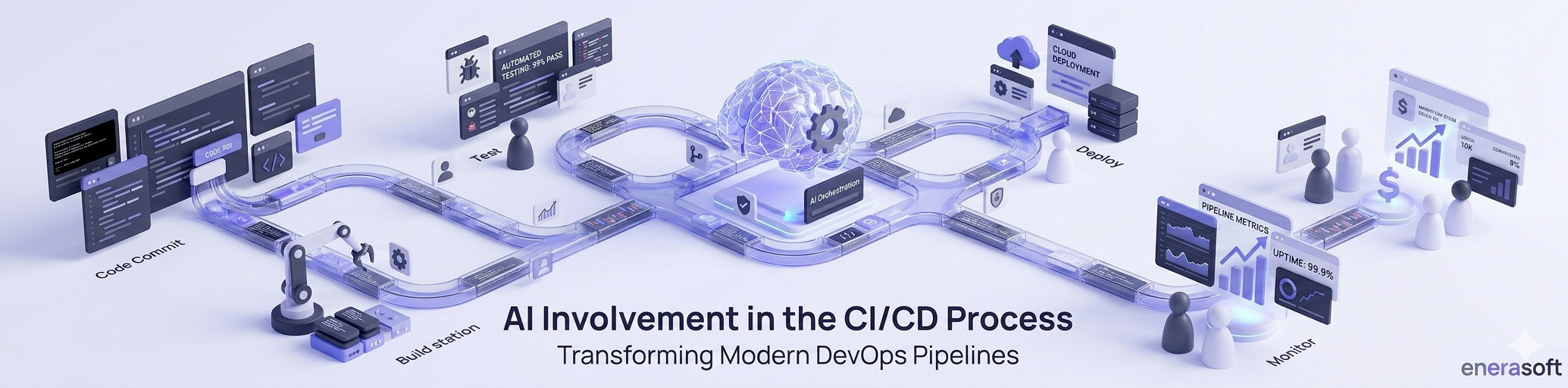
Modern software development demands speed, reliability, and scalability. Organizations are expected to deliver new features faster while maintaining software quality and minimizing downtime. This is where CI/CD (Continuous Integration and Continuous Deployment) plays a critical role.
Today, Artificial Intelligence (AI) is revolutionizing CI/CD pipelines by introducing intelligent automation, predictive analytics, and self-healing capabilities into DevOps workflows. AI-powered DevOps is no longer a futuristic concept—it is rapidly becoming the foundation of modern software delivery.
In this blog, we’ll explore how AI in CI/CD is transforming software engineering practices, improving deployment efficiency, and enabling intelligent DevOps pipelines.
Introduction
Understanding CI/CD Basics
CI/CD stands for:
- Continuous Integration (CI) – Automatically integrating code changes into a shared repository.
- Continuous Delivery/Deployment (CD) – Automatically testing and deploying applications to production environments.
Traditional CI/CD pipelines automate:
- Code integration
- Unit testing
- Build generation
- Deployment workflows
- Monitoring and rollback procedures
The primary goal is to accelerate software delivery while reducing human errors.
Typical CI/CD Workflow
Developer Commit → Build → Test → Security Scan → Deploy → Monitor
Importance of Automation in DevOps
Automation is the backbone of DevOps. Without automation, software teams face:
- Slow release cycles
- Manual deployment errors
- Inconsistent testing
- Delayed issue detection
- Operational inefficiencies
DevOps automation improves:
- Deployment frequency
- Application stability
- Team collaboration
- Operational scalability
However, traditional automation follows predefined rules. It cannot adapt dynamically to changing conditions or learn from historical data.
This limitation is where AI becomes transformative.
What is AI in CI/CD?
Defining AI-Driven DevOps
AI-driven DevOps combines:
- Artificial Intelligence (AI)
- Machine Learning (ML)
- Predictive Analytics
- Generative AI
- Intelligent Automation
To optimize software delivery pipelines.
AI systems analyze historical deployment data, logs, performance metrics, and incidents to make intelligent decisions during the CI/CD lifecycle.
Machine Learning and Generative AI in CI/CD
Machine Learning in DevOps
Machine Learning models identify patterns in:
- Failed deployments
- Infrastructure behavior
- Test coverage
- Security vulnerabilities
- Performance bottlenecks
These insights help teams predict issues before they impact production.
Generative AI in CI/CD
Generative AI tools can:
- Generate code snippets
- Create test cases
- Suggest deployment fixes
- Automate documentation
- Improve incident response workflows
Tools like GitHub Copilot and AI coding assistants are changing how developers interact with CI/CD systems.
Traditional Automation vs AI-Powered Automation
| Traditional CI/CD | AI-Powered CI/CD |
| Rule-based workflows | Adaptive decision-making |
| Static monitoring | Predictive monitoring |
| Manual troubleshooting | AI-assisted remediation |
| Fixed test execution | Intelligent test prioritization |
| Reactive incident management | Predictive incident prevention |
AI introduces intelligence into automation, enabling systems to continuously improve over time.
How AI is Used in the CI/CD Process
1. Intelligent Code Reviews
AI-powered code review tools analyze:
- Coding standards
- Security vulnerabilities
- Performance issues
- Code duplication
- Best practice violations
Example:
GitHub Copilot and AI review assistants can:
- Suggest cleaner code
- Detect logic issues
- Recommend optimizations
This significantly reduces manual review effort.
2. Automated Testing Optimization
Testing is often the slowest stage in CI/CD pipelines.
AI helps by:
- Prioritizing critical test cases
- Skipping redundant tests
- Identifying flaky tests
- Predicting test failures
Benefits:
- Faster builds
- Reduced infrastructure costs
- Improved test efficiency
3. Predictive Bug Detection
Machine learning models analyze historical bugs and deployment data to predict:
- High-risk code changes
- Potential regression failures
- Vulnerable components
This enables proactive issue resolution before deployment.
4. AI-Generated Test Cases
Generative AI can automatically create:
- Unit tests
- API tests
- Edge-case scenarios
- Regression test suites
Example Workflow:
Code Commit → AI Generates Tests → CI Pipeline Executes Tests
This improves testing coverage while reducing developer effort.
5. Deployment Risk Analysis
AI models evaluate deployment risks based on:
- Previous deployment failures
- Infrastructure changes
- Service dependencies
- Traffic patterns
The system can:
- Delay risky deployments
- Recommend safer deployment windows
- Trigger additional validation checks
6. Smart Rollback Mechanisms
Traditional rollback systems rely on manual intervention.
AI-powered rollback systems:
- Detect anomalies automatically
- Compare live metrics against baseline behavior
- Trigger instant rollback actions
This reduces downtime and customer impact.
7. Log Analysis and Anomaly Detection
Modern systems generate massive volumes of logs.
AI helps by:
- Detecting unusual patterns
- Identifying root causes
- Correlating incidents across systems
- Reducing alert fatigue
Example:
AI monitoring systems can identify memory leaks before application crashes occur.
8. Infrastructure Monitoring
AI-powered monitoring platforms analyze:
- CPU utilization
- Memory usage
- Network traffic
- Container health
- Cloud infrastructure metrics
AI systems can automatically:
- Scale resources
- Optimize cloud costs
- Predict outages
9. AI-Powered Security Scanning
Security is a critical component of DevOps.
AI security tools can:
- Detect suspicious activity
- Identify vulnerable dependencies
- Scan infrastructure configurations
- Predict attack patterns
This strengthens DevSecOps practices.
Benefits of AI in CI/CD
Faster Deployments
AI reduces pipeline bottlenecks through:
- Intelligent automation
- Smart testing
- Deployment optimization
Result:
- Shorter release cycles
- Increased deployment frequency
Reduced Downtime
AI-driven monitoring and rollback mechanisms minimize:
- Production failures
- Service interruptions
- Mean Time to Recovery (MTTR)
Improved Software Quality
AI improves quality through:
- Automated code reviews
- Better test coverage
- Predictive defect analysis
Better Developer Productivity
Developers spend less time on:
- Manual testing
- Troubleshooting
- Repetitive tasks
This allows teams to focus on innovation.
Cost Optimization
AI helps optimize:
- Cloud resource usage
- Infrastructure scaling
- Testing environments
This reduces operational costs.
Faster Incident Response
AI-powered systems detect and respond to incidents in real time, improving reliability and customer experience.
Popular AI Tools Used in CI/CD
GitHub Copilot
An AI coding assistant that helps developers:
- Generate code
- Write tests
- Improve productivity
Jenkins AI Plugins
AI plugins for Jenkins help with:
- Build optimization
- Predictive failure analysis
- Smart pipeline execution
GitLab AI Features
GitLab integrates AI capabilities for:
- Code suggestions
- Security analysis
- Merge request reviews
Datadog AI Monitoring
AI-driven observability platform that:
- Detects anomalies
- Correlates incidents
- Improves monitoring insights
Dynatrace
Provides:
- AI-powered observability
- Root cause analysis
- Automated infrastructure monitoring
Harness AI
Harness uses AI for:
- Deployment verification
- Rollback automation
- Continuous delivery optimization
New Relic AI
Helps teams:
- Analyze telemetry data
- Reduce alert noise
- Detect anomalies faster
Challenges and Risks
Data Privacy Concerns
AI systems often analyze sensitive:
- Source code
- Logs
- Customer data
Organizations must ensure compliance with:
- GDPR
- HIPAA
- SOC 2
- Security standards
False Positives in AI Predictions
AI systems may incorrectly flag:
- Healthy deployments
- Safe code changes
- Normal system behavior
This can lead to unnecessary pipeline interruptions.
AI Model Dependency
Over-reliance on AI can reduce:
- Human oversight
- Engineering intuition
- Manual validation processes
AI should augment—not replace—engineers.
Security Risks
AI systems themselves can become attack targets if:
- Training data is compromised
- AI APIs are exposed
- Access controls are weak
Learning Curve for Teams
Adopting AI DevOps requires:
- Training
- Cultural shifts
- Infrastructure modernization
Organizations must invest in skill development.
Future of AI in CI/CD
Autonomous DevOps
Future DevOps pipelines will become increasingly autonomous:
- Self-optimizing
- Self-monitoring
- Self-healing
Minimal human intervention will be required.
Self-Healing Pipelines
AI systems will:
- Detect failures
- Diagnose root causes
- Apply fixes automatically
This will significantly improve system reliability.
Best Practices for Implementing AI in CI/CD
Start Small with Automation
Begin with:
- AI-powered monitoring
- Test optimization
- Code review automation
Gradually scale AI capabilities.
Monitor AI Decisions
Maintain visibility into:
- AI-generated recommendations
- Deployment decisions
- Automated rollback actions
Human oversight remains critical.
Combine Human Review with AI
The best results come from:
- AI-driven insights
- Human engineering judgment
This hybrid approach improves reliability.
Maintain Security Compliance
Ensure:
- Secure AI model training
- Data encryption
- Access control policies
- Regulatory compliance
Security should remain a top priority.
Workflow Diagram: AI-Driven CI/CD Pipeline
Code Commit
↓
AI Code Review
↓
Automated Build
↓
AI Test Optimization
↓
Security Scanning
↓
Deployment Risk Analysis
↓
Smart Deployment
↓
AI Monitoring & Anomaly Detection
↓
Automatic Rollback (if required)
Conclusion
AI is transforming modern DevOps pipelines by introducing intelligence, adaptability, and predictive capabilities into CI/CD workflows.
From intelligent code reviews and automated testing to predictive monitoring and self-healing systems, AI in CI/CD is helping organizations deliver software faster, safer, and more efficiently.
Key Benefits
- Faster deployments
- Reduced downtime
- Improved software quality
- Better operational efficiency
- Enhanced developer productivity
As software systems continue to grow in complexity, AI-powered DevOps will become essential for maintaining scalable and resilient delivery pipelines.
Organizations that embrace intelligent CI/CD pipelines today will gain a significant competitive advantage in the future of software engineering.